Vienna: three integrations in one day, and a dead file
The second installation was the first to profit from the first. And on the same morning it wrote a configuration that never had any effect.
The Vienna flat was the second instance: nineteen days after Merano, one day before Kapfenberg.
It is the first that profited from a sister installation — and the only one that wrote a file on day one which never had any effect at all. Both can be dated to the same morning.
What was carried over from Merano
Two things, both without losing time:
The port check. Again 8123 did not answer and port 80 did. This time it was not a discovery but a confirmation — the connection script tries both anyway.
The key in the right shell. The trap with the two quotation marks, which cost half an evening in Merano, did not come up here at all.
That is the entire difference between the first and the second installation: the same traps, only already described.
Three integrations in one day — all three local
What was added on 28 August still stands today, and it stands without an account and without a subscription:
| Hue | 37 devices, 156 entities, through the bridge in the house |
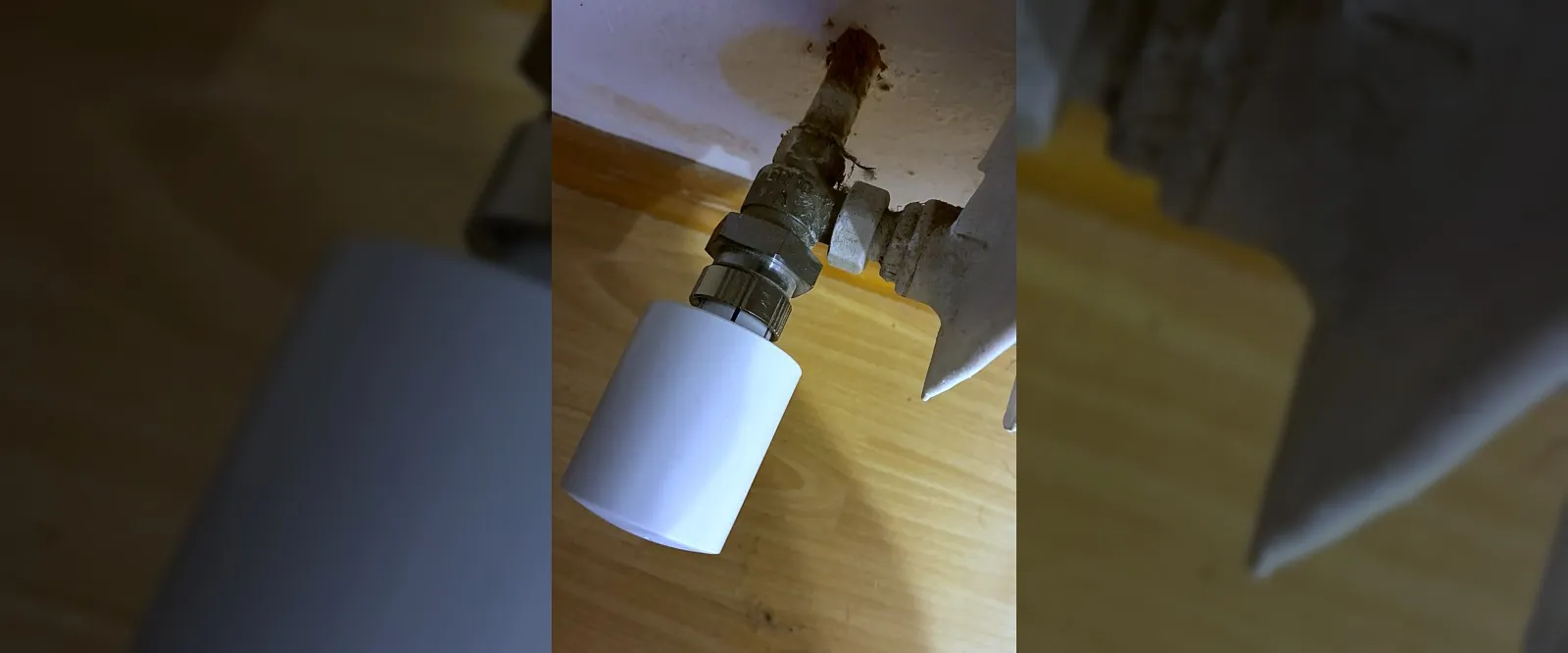
| tado | twelve thermostats over HomeKit, not through the cloud |
| The direct line | Home Assistant reachable from the assistant itself |
With Hue the remarkable thing was how little there was to do: Home Assistant found the bridge by itself and adopted the rooms from the Hue app as areas — 36 of 37 devices were assigned immediately. The only thing left without an area was the bridge itself.
With tado it was the opposite: the dialog Home Assistant offers of its own accord leads into the cloud. The local route has a different name, has to be started by hand — and did not offer tado at all at first, because a HomeKit accessory allows only one controller and that slot was taken.
And the file that never worked
On the same day a configuration file was created that was supposed to secure remote access. It was syntactically correct, the checker reported it as valid, and the documentation listed the setting as “in place”.
Eleven days later it turned out: it had been ineffective from its very first minute.
The reason is in a timestamp. Home Assistant moves this setting once into an internal store, and from then on the store wins. That store was created at:
created_at 2026-08-28T06:41:36That is, on the morning of day one — before my file had even been written. The migration froze the state from initial setup, and everything that went into the YAML afterwards was dead weight.
It cost a full evening, ten days later: 400 Bad Request, and my config had never been active.
The first day of an installation fixes what will later be true. You only notice that when you measure it — and nobody measures something on day one that has only just been set up.
The uncomfortable punchline
The same problem was solved and written down in Kapfenberg one day later — including the explicit sentence that Vienna and Merano are affected in the same way.
Vienna was moved to a newer version on 5 September. The note had been sitting there for ten days. I did not read it, and opened the Home Assistant source code instead.
So the second installation profited from the first — and the third would have helped the second, if somebody had looked in the right file.
What I’d suggest
- Use the sister installation if you have one. The two things that went smoothly in Vienna went smoothly because they had gone wrong in Merano.
- On day one, measure whether your configuration takes effect — not whether it exists. The difference costs one query.
- Look at the timestamp when something does not take. Here the answer was in a single field.
- Take the local route for Hue and tado, even when the offered dialog leads elsewhere. Both have run here without an account since day one.
- Read the note you wrote yourself. Ten days are enough to forget it.
So what?
Of the three installations this is the most instructive, because it shows both: knowledge that transferred — and knowledge that was lying ready and still did not arrive.
The port number and the key trap came from Merano and cost nothing that day. The ineffective configuration file sat in the project from 06:41 onwards and cost an evening eleven days later.
The difference between the two is not how hard the problem was. It is whether somebody looked in the right file at the right moment.
If you want to follow this: use RSS
No newsletter. You give me no address, I keep no list, and nobody has to agree to anything to learn that an article is finished. RSS is the older and, for both sides, the more honest solution.
How it works, and why no newsletter
- 1Get a feed reader. No account needed with an app on your phone or a browser extension; use a hosted service if you prefer.
- 2Add the address above to it.
- 3Done. New articles turn up in your reader by themselves — unread stays unread, and nothing lands between invoices and ads in your inbox.
Why that is better: your reader fetches the file. I get no address and cannot see who reads or whether anyone opened it. Unsubscribing means deleting the entry — no link, no confirmation mail, no me.
Related
Flatness was the proof — two lines, two wrong suspects
Two radio links, two months of measurement. In Kapfenberg the culprit was my own automation, in Merano the measuring tool itself.
For thirteen hours the shut-off hung on the cloud
A network outage, two new addresses — and the local path to both water valves was dead. Why fixed addresses matter most when you work locally.
What a radiator thermostat measures is not your room
Three homes, three ways to a radiator: tado over HomeKit, Shelly over Zigbee, and once no valve at all. What each gives you — and what none of them can do.