35 minutes of cooling, zero degrees colder — the proof run
The air conditioner ran and did not cool. "Cools badly" is not a finding. How a complaint became a measurement series the engineer confirmed.
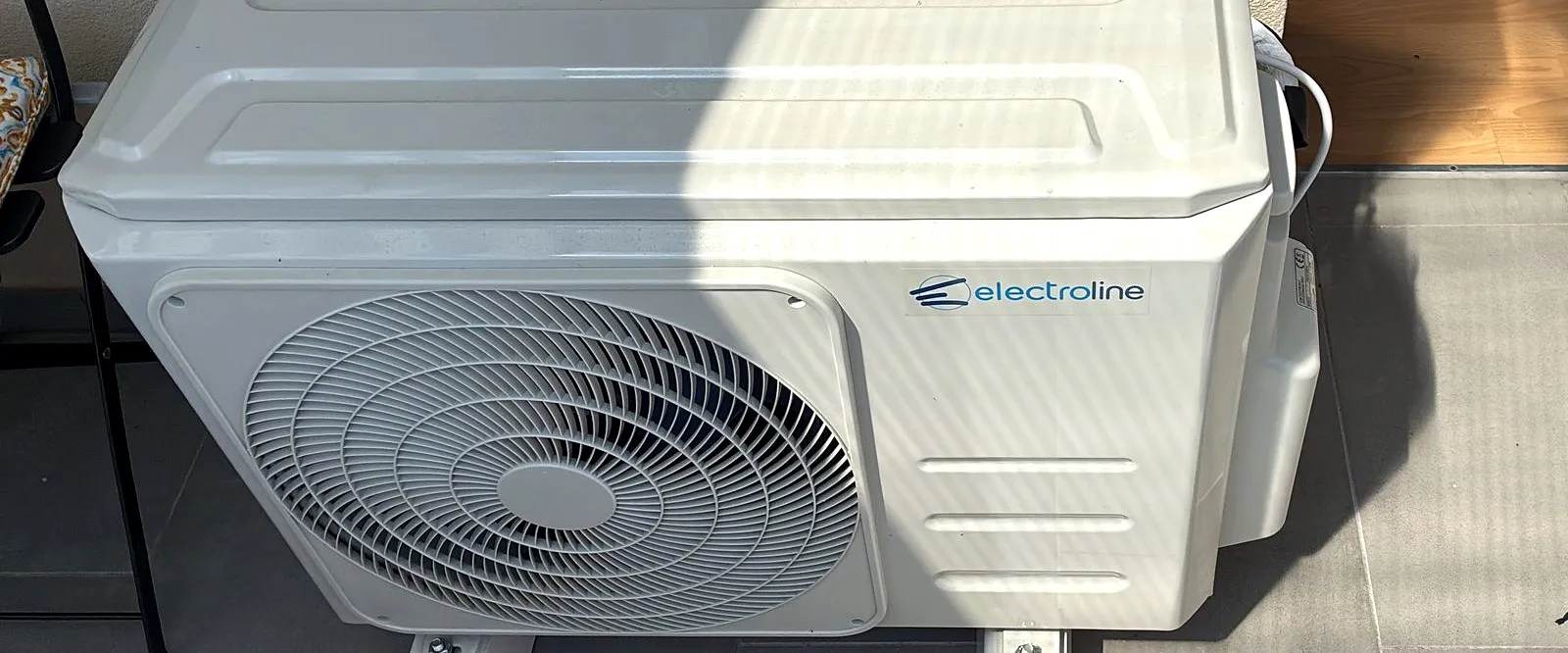
The air conditioner in Merano — a Midea multisplit — ran. It just did not cool.
That is the kind of complaint that gets you nowhere with any contractor, and nowhere by yourself either. “Cools badly” is not a diagnosis. It could be the unit, the setting, the room size, open windows, or simply expecting too much.
In the end it was dramatically too little refrigerant. The engineer established that, not my measurement series. What my series achieved is something more modest and still decisive: it ruled out the obvious explanations one by one and turned a complaint into a question you can put to a technician.
That is what this article is about. Not the repair, but the road from feels too warm to here are the numbers.
Why the first measurements were worthless
There were already numbers. The unit kept shutting off, and that looked like a finding.
It was not, for a reason that is easy to miss: only one indoor unit was running, with a small gap to the setpoint.
A stop could equally mean “setpoint reached”. On a multi-split, the minimum output easily exceeds a small load.
In other words: the unit had an excuse. Every shutdown could be read as normal behaviour. That never becomes a finding, however often you measure.
The condition under which there is no excuse left
So: a test under real load:
| Indoor units | one, the bedroom |
| Room temperature | 26.5 °C |
| Setpoint | 22 °C |
| Gap | 4.5 K |
| Fan | high |
The decisive sentence is in my notes, and it is the principle behind this whole article:
Under these conditions the unit must run through. Any interruption is then a finding and not a matter of judgement.
That is the difference between observing and measuring. Observing means waiting for something to happen and interpreting it. Measuring means creating a situation in which only one interpretation remains possible.
What came out of it
35 minutes, sampled every 30 seconds:
| Start | Run time | Peak | Room at shutdown |
|---|---|---|---|
| 08:31 | 13.0 min | 568 W | 4.0 K above setpoint |
| 08:47 | 4.0 min | 581 W | 4.5 K above setpoint |
| 08:54 | 4.0 min | 576 W | 4.5 K above setpoint |
| 09:01 | 4.0 min | 598 W | 4.5 K above setpoint |
Between each, exactly 3.0 minutes of pause — the compressor’s minimum rest.
Three things in there are the finding:
All four shutdowns happened while the room was 4 to 4.5 K too warm. Not one was a reached setpoint. The excuse is gone.
The room temperature fell by zero over 35 minutes. The sensor in the indoor unit stayed at 26.5 °C. An independent sensor in the room went from 27.2 to 27.3 °C — slightly up.
Peak power stayed capped at 570 to 600 watts, where a 4.5 K gap on a high fan setting should draw considerably more.
Together that is a clear statement: a protective shutdown, not modulating down.
The second independent sensor is not decoration here. With only the indoor unit measuring, the objection “maybe the sensor is wrong” would stand. Two sources both seeing nothing fall rule that out.
The pressure readings explain everything in hindsight
The answer then came from the technician’s gauge, not from Home Assistant:
| Suction pressure | Evaporating temperature | |
|---|---|---|
| before | 3 bar | about −20 °C |
| after | 9.5 bar | about +10 to 11 °C |
At −20 °C evaporation every symptom is explained: the ice at the connection, the protective shutdowns (the suction gas no longer cools the compressor motor and the discharge temperature runs away), the capped power draw and the absent cooling.
It was not slightly too little refrigerant. It was dramatically too little.
Who did what: the recharge was done by the air conditioning technician. I do not touch the refrigerant circuit myself — that takes tools, licensing and practice I do not have.
My part was the measurement. And that is exactly the part that made the difference: the technician did not arrive to a “cools badly” but to a table with four shutdowns at a 4.5 K gap and zero degrees of temperature fall. That shortens the search to a single pressure reading.
The control test, deliberately harder
After the technician had recharged it, the same test was not repeated. A stricter one was:
| morning | evening | |
|---|---|---|
| Indoor units / load | one / 4.5 K | both / 7.5 K |
| longest run | 13.0 min, then cycling | 26.6 min continuous |
| forced pauses | 3 × 3.0 min | none |
| power | 568–598 W capped | 1695 → 1245 W |
| room temperature | fell by zero | −3.0 K and −3.5 K |
54 sample points at half-minute intervals, lowest value 1245 watts, not a single standstill. The unit ran straight through the 12-to-17-minute window in which it had previously shut off every time.
That the control test was harder than the original is not a detail. An after-measurement under easier conditions proves nothing — it invites attributing the improvement to the lighter load.
The finest detail is the falling power
1695 → 1245 watts with the compressor still running.
That is precisely what the diagnosis hung on: an inverter that has cooled enough reduces its frequency and keeps running. It does not stop every three minutes.
In the morning the power was rigid at 570 to 600 watts and the unit stood still constantly. In the evening it modulates. That is healthy behaviour, not cycling.
The measurement was stopped after 26.6 of a planned 40 minutes because the flat was getting too cold. The evidence was conclusive anyway.
And the cause was not a leak
The obvious explanation would be: refrigerant is not consumed, so it must have escaped. The explanation that fits the data better is a different one.
A line that is too long needs a charge supplement per metre beyond the factory fill. Without it the system is marginal from the start — not gradually. On top of that came a one-off loss at switch-on.
The difference is measurable: a slow leak would have shown a gradual decline. Here the charge was permanently marginal.
In hindsight that also explains an earlier incident where shifting charge between circuits suddenly caused ice at the connection and a protective shutdown: with an already marginal total charge, that was enough to tip one circuit into overfill. At the correct charge the same action would have been harmless.
Why the unit was under scrutiny at all
There is a second reason to know this air conditioner precisely in this flat: the supply capacity is limited. Measured:
| Hob on boost | 2,292 W |
| Multi-split, both rooms | 1,378 W |
| together | 3,670 W = 111 % of what is permitted |
Hence a staged load shedding. And the first stage is not the air conditioner but the washing machine — it resumes its programme by itself after an interruption, so shedding it has no consequences. A switched-off air conditioner is immediately noticeable at 29 °C, and the compressor has to wait out its protection pause on return.
The fridge is never shed. Food is more expensive than a meter trip, and at 76 watts it contributes almost nothing anyway.
And a trap that fits the topic
Switching back raises the question: was it even on before?
The living room unit hangs on an infrared bridge with no return channel. One day Home Assistant showed “cooling” while the device drew 3.3 watts and the room stood at 30.5 °C.
Rely on the reported state there and you will later switch on a unit that never ran.
So the state is established through consumption, not through the display. The same principle as with the UPS and the stove: what a device claims about itself is the weakest source available.
So what?
The transferable part is not the refrigerant. It is the method.
- Create a situation that leaves no excuse. With a small gap to the setpoint every shutdown means something. At 4.5 K it means exactly one thing.
- Measure with two independent sources. A sensor inside the device alone invites the objection that it reads wrongly.
- Make the control test harder, not easier. Otherwise you attribute the improvement to the gentler conditions.
- Watch the shape, not just the value. Rigid power with constant standstill versus modulating power under continuous running — that is the difference between sick and healthy, and it appears in no error message.
- Do not ask the device, measure the consumption. A status report without a return channel is a claim.
And the real use of home automation at this point: not controlling the unit but turning a complaint into a table. “Cools badly” can be disputed. Four shutdowns at a 4.5 K gap, zero degrees of temperature fall in 35 minutes and capped power draw cannot.
If you want to follow this: use RSS
No newsletter. You give me no address, I keep no list, and nobody has to agree to anything to learn that an article is finished. RSS is the older and, for both sides, the more honest solution.
How it works, and why no newsletter
- 1Get a feed reader. No account needed with an app on your phone or a browser extension; use a hosted service if you prefer.
- 2Add the address above to it.
- 3Done. New articles turn up in your reader by themselves — unread stays unread, and nothing lands between invoices and ads in your inbox.
Why that is better: your reader fetches the file. I get no address and cannot see who reads or whether anyone opened it. Unsubscribing means deleting the entry — no link, no confirmation mail, no me.
Related
What does a flat cool towards? Not the outside air
Seven hours with no heat in the circuit, and the question of how far to preheat. The answer hung on a figure I had assumed wrongly at first.
The washing machine reports in — if you let it
Programme, temperature and spin speed on my phone, locally and without a vendor account. And why the same brand could not be connected at all in Merano.
HACS is built in now — and my hand-installs were invisible
Home Assistant 2026.11 leaves nothing of HACS to install. What changes, what breaks in templates, and why manually installed integrations do not show up.